An Economic Reality Check for Recruiters and Career Coaches
2026-01-19
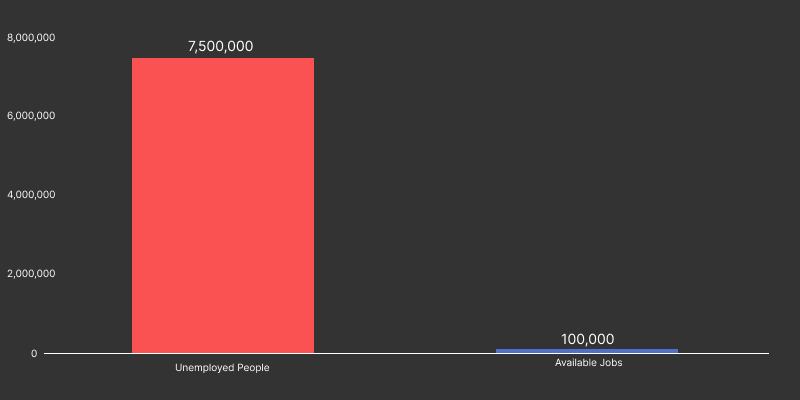
This message is directed at recruiters and career coaches who are actively selling paid resume rewrites, profile optimizations, and related services in the current labor market.
The intent may be understandable, earning income from professional skills, but the strategy ignores basic economic math.
The United States is operating in recession-like labor conditions. Household savings are depleted, credit usage is rising, and many job seekers are facing long-term unemployment or housing insecurity. In this environment, asking unemployed workers to spend $100–$400 on resume services does not address the core problem they face.
That problem is not employability. It is job scarcity.
The Labor Market Imbalance
At present, the number of unemployed workers dramatically exceeds the number of available jobs. According to recent reporting, there are approximately 7.5 million unemployed people competing for roughly 100,000 open roles. This is not a marginal imbalance, it is a structural one.
Even if every job seeker had a perfectly optimized resume, mathematically most would still not be hired, because the jobs do not exist in sufficient quantity.
This is simple supply and demand:
- Labor supply: millions of qualified workers
- Labor demand: a fraction of that number
- Result: extreme competition, prolonged unemployment, and hiring paralysis
No resume rewrite can alter that equation.
Why Resume Optimization Fails in a Recession
Resume services are built on an implicit promise: “If you present yourself better, you will get hired.”
That logic only holds in a labor market where:
- Employers are actively hiring
- Job openings exceed or roughly match applicants
- Small advantages meaningfully change outcomes
None of those conditions are present.
Many companies are:
- Under hiring freezes
- Conducting layoffs while reposting “ghost jobs”
- Holding roles open indefinitely to wait for an ideal candidate
The few employers who are hiring can afford to be unrealistically selective. They are searching for candidates who can perform the work of multiple senior employees while accepting reduced compensation. This is not because job seekers are lacking, it is because the market allows employers to behave this way.
The Ethical Problem With Selling Hope
Selling resume rewrites during a recession relies on false causality, the idea that unemployment is primarily caused by poor presentation rather than insufficient demand for labor.
That framing shifts responsibility away from macroeconomic conditions and places it on individuals who already lack financial security. In economic terms, this is selling optimization in a market constrained by quantity, not quality.
If resume services truly produced consistent job placement outcomes, the logical pricing model would be outcome-based.
For example:
- No job offer, no fee
- Payment only if employment is secured within a fixed timeframe
If that guarantee cannot be made, it is an admission that the service does not materially change employment probability in the current market.
Conclusion
This labor market is not broken because workers failed to brand themselves correctly. It is broken because there are far fewer jobs than people who need them.
Until job creation meaningfully outpaces unemployment, selling resume rewrites and similar services is not a solution, it is a financial burden placed on those least able to carry it.
That is not opinion. That is math.